AI In U.S. Animal Health Market Summary
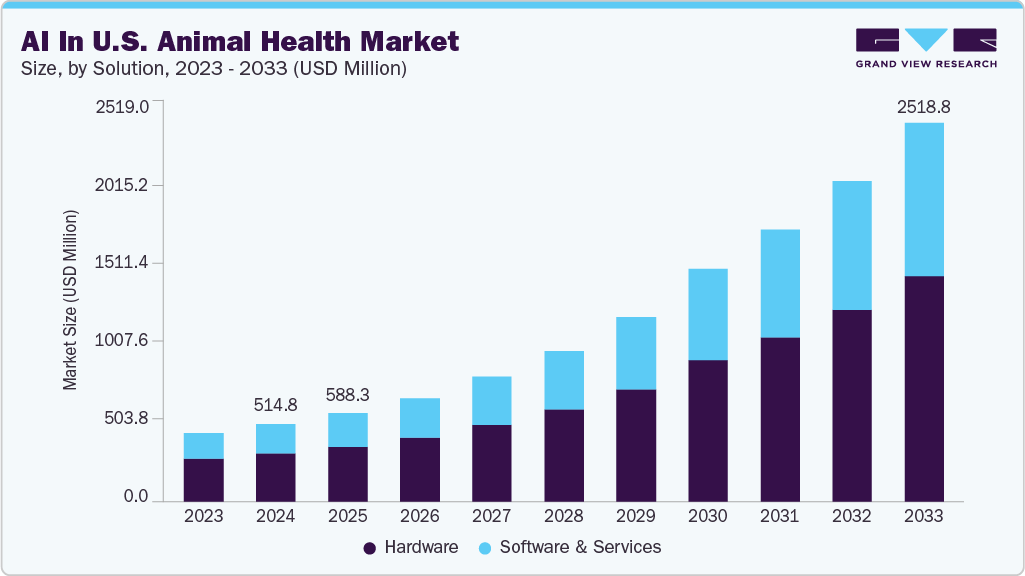
The AI in U.S. animal health market size was estimated at USD 514.83 million in 2024 and is projected to reach USD 2,518.84 million by 2033, growing at a CAGR of 19.94% from 2025 to 2033. The market is growing rapidly due to increasing demand for faster, more accurate diagnostics, rising prevalence of pet diseases, increasing pet ownership, and spending on advanced veterinary care.
Key Market Trends & Insights
- By solution, hardware segment held the largest share of 62.76% of the market in 2024
- By animal type, companion animals segment largest in the market in 2024.
- By application, diagnostics dominated the market with the largest revenue share in 2024.
Market Size & Forecast
- 2024 Market Size: USD 514.83 Million
- 2033 Projected Market Size: USD 2,518.84 Million
- CAGR (2025-2033): 19.94%
In addition, artificial intelligence (AI) integration in diagnostic imaging, predictive analytics, and remote monitoring enhances clinical efficiency and early disease detection. The Artificial Intelligence in U.S. animal health market is rapidly evolving, driven by the growing demand for faster, more accurate diagnostics and the increasing use of digital tools in veterinary practices. AI technologies are revolutionizing veterinary care by automating image analysis, streamlining diagnostics, and enhancing clinical decision-making. Companies such as Zoetis are leading innovation with AI-powered solutions such as Vetscan Imagyst, which provides automated cytology and fecal analysis, enabling veterinarians to diagnose conditions within minutes. Similarly, IDEXX Laboratories and Mars Petcare’s ANTECH are integrating AI into imaging and pathology platforms to enhance diagnostic precision and operational efficiency across veterinary networks.
Beyond diagnostics, AI is expanding into preventive care, disease prediction, and personalized treatment planning. Wearable devices and remote monitoring systems, such as those developed by Whistle Health and PetPace, use AI algorithms to track vital signs, detect behavioral changes, and alert owners or veterinarians to potential health issues in real time. These innovations address the nationwide shortage of veterinary professionals by improving workflow automation and enabling data-driven care.
Strategic partnerships and technological convergence further support the market’s growth. For instance, Covetrus Pulse integrates seamlessly with Zoetis Diagnostics, linking AI-powered tools such as Imagyst to cloud-based management systems for faster data sharing, billing accuracy, and improved patient outcomes. With continued advances in machine learning, connectivity, and cloud infrastructure, AI is poised to redefine animal healthcare delivery in the U.S., making diagnostics more accessible, efficient, and proactive across both companion and production animal sectors.
AI-based Veterinary Products are Currently Available in the U.S.
|
Product Name
|
Manufacturer
|
Features
|
Applications
|
|
Vetscan Imagyst (with AI-Masses app)
|
Zoetis Inc.
|
AI-powered image recognition for cytology of lymph node & skin/subcutaneous masses; integrates with digital cytology workflow.
|
In-clinic screening of potentially neoplastic masses in dogs & cats for faster diagnosis.
|
|
Vetscan OptiCell
|
Zoetis Inc.
|
Cartridge-based hematology analyzer using AI and viscoelastic focusing for complete blood count (CBC) quickly in the clinic.
|
Point-of-care hematology diagnostics in veterinary clinics (dogs, cats) to speed up workflow.
|
|
SignalSMILE (dental radiology AI)
|
SignalPET
|
AI tool for dental radiographs identifies common pathologies in companion animals, such as furcation loss, resorptive lesions, and fractures.
|
Veterinary dental x-ray interpretation in companion animals (dogs/cats) to improve diagnostic confidence.
|
|
SignalSTAT (AI + human oversight radiology service)
|
SignalPET
|
24/7 AI-plus-human radiology interpretation of critical companion-animal x-rays with fast turnaround (~45 min).
|
Urgent radiographic interpretation support in clinics when a specialist radiologist is not immediately available.
|
|
AI Radiology Platform (Vetology)
|
Vetology Innovations LLC
|
Cloud-based AI radiology + teleradiology service: multi-modality, automated screening for dogs/cats, integrates with clinic software.
|
Radiograph interpretation for companion animals supports clinics with workflow, automation, and faster diagnostics.
|
Market Concentration & Characteristics
The U.S. AI in animal-health market is moderately concentrated, extensive, diversified diagnostics and animal-health incumbents (notably Zoetis, IDEXX, and Mars/Antech) command the lion’s share of revenues by embedding AI into established imaging, lab, and connectivity platforms, while a growing tier of specialist AI firms (e.g., Vetology, SignalPET, ImpriMed) supply niche services and drive innovation, creating a two-speed market of dominant incumbents plus many agile startups. Consolidation and strategic partnerships (acquisitions, lab roll-ups, and tech alliances) are strengthening incumbent strength, but continued venture investment in AI-native companies is keeping competitive pressure and innovation high.
Innovation in the market is advancing rapidly, with companies deploying innovative technologies that span diagnostics, monitoring, and treatment. For example, Zoetis has upgraded its Vetscan Imagyst platform with new AI capabilities for dermatology and equine faecal-egg-count analysis. Meanwhile, firms such as ImpriMed Inc. are using AI to personalize cancer therapies for dogs by analyzing biopsy data and predicting drug responses. At the same time, integrating wearables and remote-monitoring systems (e.g., real-time sensors analyzing animal behavior) creates new data-driven ecosystems for pets and production animals. This high degree of innovation is reshaping veterinary care workflows and enabling more innovative, faster interventions across the animal‐health spectrum.
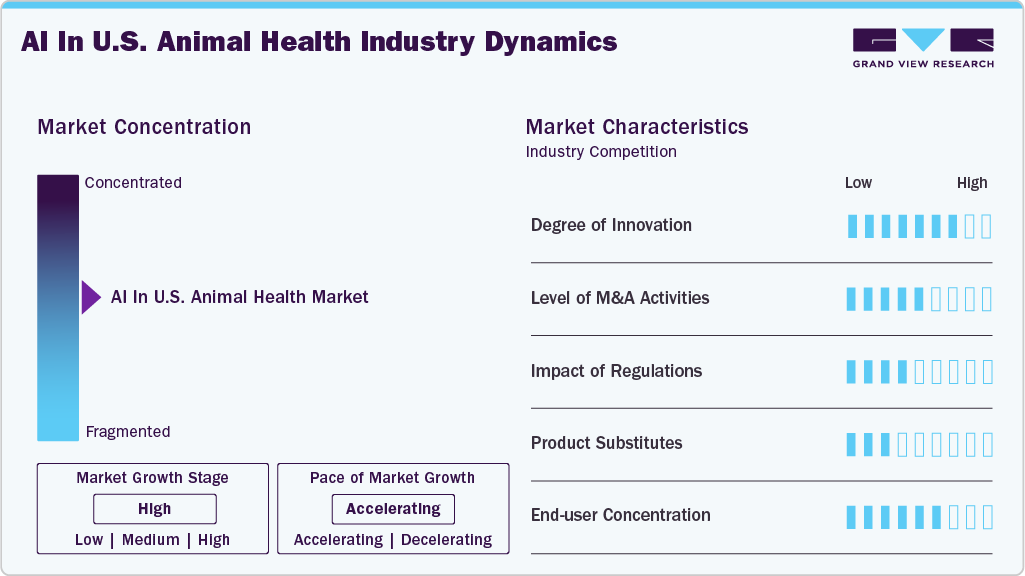
M&A activity specifically targeting AI capabilities in the U.S. animal health market is still emerging and gaining momentum. For example, SK Telecom Co. partnered with Vetology LLC in 2024 to introduce an AI-pet diagnostic assistant in the U.S., highlighting early strategic investments in AI platforms rather than traditional pharmaceutical mergers. While complete acquisitions of AI-native veterinary players remain limited in public records, the growing interest from large animal-health firms and tech companies signals a rising trend toward consolidation around AI diagnostics, monitoring, and data-platform businesses in the sector.
Regulation significantly influences the deployment of AI in the U.S. animal-health market, particularly through the Food and Drug Administration’s (FDA) evolving frameworks. While AI devices for animal use currently face no mandatory pre-market approval under veterinary device regulations, increasing U.S. regulatory attention on AI/ML and veterinary innovation is shaping the landscape. For instance, the FDA’s “Animal and Veterinary Innovation Agenda” commits to “risk-based, flexible” oversight to support novel products, including AI diagnostics. Meanwhile, draft guidance titled “Considerations for the Use of Artificial Intelligence to Support Regulatory Decision-Making” signals future deeper scrutiny into how AI is used in veterinary and animal-health product development.
In the U.S. AI animal-health market, product substitutes to AI-driven solutions include traditional manual diagnostics, veterinarian tactile assessments, and conventional software platforms that lack machine-learning capabilities. While AI tools such as the GREENIES Canine Dental Check or the Vetscan Imagyst platform offer automated image analysis and predictive modelling, many practices still rely on human-only evaluations or standard monitoring systems without AI functions. These non-AI alternatives remain viable, especially in smaller clinics or farms with limited budgets, and they act as the primary substitution threat to AI-powered deployments.
End-user concentration in the U.S. AI animal-health market is highest among veterinary clinics and hospitals, which drive revenue through rapid adoption of AI diagnostics, imaging, and practice-management tools. Diagnostic labs and large hospital networks (e.g., IDEXX, VCA, Banfield) also account for substantial usage and purchases. Production-animal operations and farmers are fast adopters of scale-focused monitoring and precision-farm systems. Pet parents fuel demand for consumer-facing AI apps and wearables, creating a two-tier concentration between clinical/professional buyers and end-consumer channels.
Solution Insights
On the basis of solution, hardware held the largest revenue segment with a share of 62.76% in 2024, owing to the widespread adoption of AI-enabled diagnostic imaging systems, wearable sensors, and monitoring devices in both companion and production animal care. These tools collect continuous health and behavioral data, enabling real-time monitoring and early disease detection. For example, tools such as IDEXX’s digital imaging systems, FitBark’s pet activity trackers, and Allflex Livestock Intelligence’s smart sensors are gaining popularity. Furthermore, the growing integration of AI algorithms into hardware for automated diagnostics, remote monitoring, and data acquisition has driven demand across veterinary clinics and farms, establishing hardware as the dominant segment in the market.
Software & Services is the fastest-growing segment in the market, since the veterinary clinics and farms are increasingly adopting cloud-based platforms, AI analytics, and remote monitoring services to interpret the wealth of data generated by hardware sensors and imaging systems. These solutions, such as digital pathology review platforms, AI-driven diagnostic software, and managed services for fleets of connected devices, deliver higher value through insights and workflow optimization rather than just equipment sales. For example, companies such as Vetology LLC provide AI-based radiology interpretation services that convert large image datasets into actionable reports, illustrating how services and software are becoming key to delivering the full benefit of AI in animal health.
Animal Type Insights
On the basis of animal type, the companion animals segment accounted for the largest revenue segment in the market, due to the rising rate of pet ownership, increasing humanization of pets, and growing demand for advanced veterinary care. Pet parents are increasingly adopting AI-powered tools for diagnostics, wellness monitoring, and preventive healthcare. Innovations such as IDEXX’s AI diagnostic imaging, Mars Petcare’s GREENIES Canine Dental Check, and wearable health trackers provide real-time insights into pet health, enabling early disease detection and personalized treatment. The surge in pet insurance coverage and higher spending on pet wellness further contribute to this segment’s continued dominance and rapid growth.
The production animals are the fastest-growing segment in the market with the highest CAGR, attributed to the increasing need for efficient livestock management, disease prediction, and productivity optimization amid rising demand for meat and dairy products. AI technologies such as machine learning-based health monitoring, precision feeding, and reproductive tracking enable early detection of diseases and improved yield efficiency in cattle, poultry, and swine. Companies such as Cargill, Connecterra, and Cainthus are deploying AI-driven solutions to monitor animal behavior, detect stress or illness, and enhance herd performance, leading to reduced losses and improved profitability, driving this segment’s high growth rate.
Application Insights
On the basis of application, diagnostics dominated the market with the largest revenue share in 2024, due to the widespread adoption of AI-powered imaging and diagnostic tools that enhance accuracy and speed in disease detection. The increasing prevalence of pet diseases and the growing demand for real-time, non-invasive diagnostics have driven this segment’s growth. Leading players such as IDEXX Laboratories, Vetology AI, and SignalPET use advanced algorithms for radiology, cytology, and pathology, enabling veterinarians to deliver faster, more precise diagnoses and improved clinical outcomes.
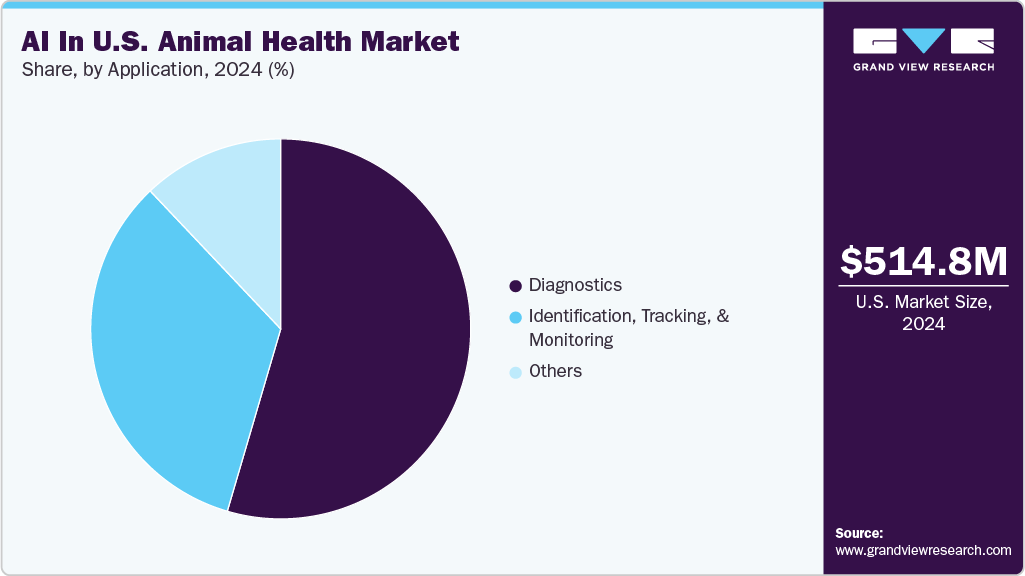
The other segment is projected to grow at the highest CAGR during the forecast period. It includes emerging applications of AI in animal health, such as drug discovery & development, precision medicine, etc. AI applications beyond such as drug discovery, development, and precision medicine enable faster, cost-efficient R&D through predictive modeling and data-driven target identification. Advancements in genomics, wearable data, and computational biology are fueling personalized treatments for animals, with companies such as Zoetis and Elanco integrating AI to accelerate new drug discovery and precision therapeutics.
Key AI In U.S. Animal Health Company Insights
Key players in the artificial intelligence in the U.S. animal health market include Zoetis Inc., IDEXX Laboratories, Mars Petcare (via Antech Diagnostics and Waltham Petcare Science Institute), SignalPET, and Vetology AI. These companies are leading innovation in AI-powered diagnostics, imaging, and digital pathology. For example, Zoetis’ Vetscan Imagyst and IDEXX’s imaging AI suite enhance in-clinic diagnostic accuracy, while Vetology AI and SignalPET specialize in automated radiology interpretation and workflow optimization for veterinary practices.
Key AI In U.S. Animal Health Companies:
- Zoetis Services LLC
- Merck & Co., Inc.
- Heska Corporation
- SignalPET
- VetCT
- Vetology LLC
- OneCup AI
- Petriage
- ImpriMed, Inc.
- IDEXX Laboratories, Inc.
Recent Developments
-
In June 2025, Zoetis introduced AI Masses, a new AI-powered cytologic tool for its Vetscan Imagyst analyzer. This tool enables rapid and accurate in-clinic screening of lymph node and skin/subcutaneous lesions.
-
In May 2025, Mars, Incorporated launched a suite of AI-powered digital health tools to help pet parents monitor their pets’ well-being. The first tool is the GREENIES Canine Dental Check, which analyzes a dog’s teeth and gums via smartphone photos.
-
In September 2024, Pontosense acquired RExSense, a pioneer in pet care technology, to advance wireless sensing solutions for veterinary use. The partnership aims to enhance pet safety by enabling real-time, non-invasive monitoring of vital signs before, during, and after surgery.
AI In U.S. Animal Health Market Report Scope
|
Report Attribute
|
Details
|
|
Market size value in 2025
|
USD 588.30 million
|
|
Revenue forecast in 2033
|
USD 2,518.84 million
|
|
Growth rate
|
CAGR of 19.94% from 2025 to 2033
|
|
Actual data
|
2021 – 2024
|
|
Forecast period
|
2025 – 2033
|
|
Quantitative units
|
Revenue in USD million/billion and CAGR from 2025 to 2033
|
|
Report coverage
|
Revenue forecast, company ranking, competitive landscape, growth factors, and trends
|
|
Segments covered
|
Solution, animal type, application
|
|
Country scope
|
U.S.
|
|
Key companies profiled
|
Zoetis Services LLC; Merck & Co., Inc.; Heska Corporation; SignalPET; VetCT; Vetology LLC; OneCup AI; Petriage; ImpriMed, Inc.; IDEXX Laboratories, Inc.
|
|
Customization scope
|
Free report customization (equivalent up to 8 analysts working days) with purchase. Addition or alteration to country, regional & segment scope.
|
|
Pricing and purchase options
|
Avail customized purchase options to meet your exact research needs. Explore purchase options
|
AI In U.S. Animal Health Market Report Segmentation
This report forecasts revenue growth at U.S. and provides an analysis of the latest industry trends in each of the sub-segments from 2021 to 2033. For this study, Grand View Research has segmented the AI in U.S. animal health market report based on solution, animal type, and application:
-
Solution Outlook (Revenue, USD Million, 2021 – 2033)
-
Hardware
-
Software & Services
-
-
Application Outlook (Revenue, USD Million, 2021 – 2033)
-
Animal Type Outlook (Revenue, USD Million, 2021 – 2033)
-
Companion Animals
-
Production Animals
-
link