


A couple of decades ago, if you were headed out of town and didn’t have anyone to look after your dog, you’d drop it off at the vet for a couple of days. And when you were at work, your pup waited until you got home, chewing your slippers and eyeing the carpets with questionable intent.
Today, pet owners can send their dogs for daytime visits or overnight stays to facilities that feel like four-legged sleepaway camps or amusement parks, complete with luxury suites, live video streams, ball pits, splash pools and more.


Welcome to the modern — and booming — pet day care industry, which generates about $1.7 billion annually in the United States, according to industry reports, and is expected to grow by nearly 9% a year through this decade. As U.S. pet ownership has reached record levels, and more pet owners treat their four-legged friends like family members, the range of products and services available to them has grown dramatically. Pet day care, with its evolving menu of upgrades and experiences, is one of the fastest-growing sectors.
In Louisiana, both franchisees of national chains and locally owned doggie day cares are vying for a piece of the action, with dozens of businesses operating in the state and several more opening each year.
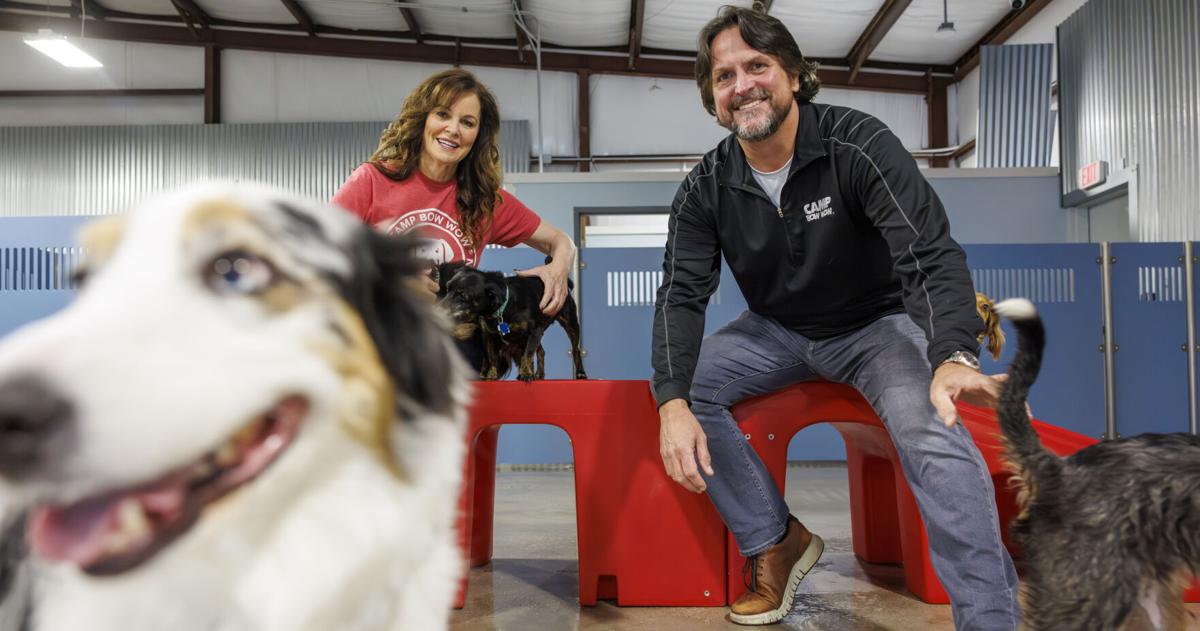
Husband-and-wife business partners Scarlett and Jason Dalton, who live in downtown New Orleans, have been major contributors to the category’s growth as the largest franchisees of Camp Bow Wow, a national chain that has grown to more than 200 locations since it was founded in the early 2000s. The Daltons’ 14 locations, including five in Louisiana, gross roughly $16 million annually and employ 300 people.

Camp Bow Wow owners Jason and Scarlett Dalton get wet kisses as they check on dogs under their care at their Metairie location on Monday, January 5, 2026. (Photo by Chris Granger, The Times-Picayune)
From their unique vantage point, they’ve witnessed the birth of an industry while capitalizing on its growth.
“There really wasn’t day care two decades ago, just traditional veterinarian boarding,” Scarlett Dalton said. “Now the sky’s the limit.”
From local dog grooming to national business
Scarlett Dalton began her pet care career by launching a mobile dog grooming business in a converted postal van in 2004 in Covington. She had dreams of eventually opening a boarding facility that would be a “posh pet hotel.” She and Jason Dalton learned about Camp Bow Wow a few years later when they saw an ad in an airline magazine.
They opened their first camp in 2009 in Covington. Five years later, they doubled the northshore facility’s size from 6,000 to 12,000 square feet. In 2017, they opened a second outpost in Mobile, Alabama, setting the stage for a dozen more openings or acquisitions over the next decade. Now the Daltons’ business footprint stretches from Albuquerque, New Mexico, to Boca Raton, Florida, and as far north as Indianapolis. At least four more camps are in development.
A reading and play area inside Camp Bow Wow in Metairie on Monday, January 5, 2026. (Photo by Chris Granger, The Times-Picayune)
At their facilities, customers spend about $30 a day for day care and about $50 per night for overnight stays, although both prices can climb depending on location and services requested. Grooming provides 10% of overall revenue, but the option is limited by the number of trained groomers the Daltons can employ, and it’s a tough job to fill.
“People are very particular about their dogs’ haircuts,” Jason Dalton said.
Boarding and day care contribute almost equally to the company’s bottom line, but the ratio varies by area.
“In Covington, there are more single-income households, so people don’t need day camp as much, but they use our boarding services because they travel frequently,” Jason Dalton said. “In Mid-City, where many people work in hospitality, it’s the opposite.”
Like all pet care businesses, the Daltons face headwinds that include staffing challenges, inflation, regulation compliance, rising insurance costs and potential oversaturation as more competitors enter the market.
Franchise fees are in the $50,000 range for new franchisees and $35,000 for existing operators looking to expand, but the cost to open a new location is likely to hit $1 million for renovations, equipment, inventory, permits and other expenses, the Daltons say. They own eight of their buildings and lease the other six. Monthly overhead costs range from $50,000 to $70,000.

Camp Bow Wow owners Jason and Scarlett Dalton, center, walk down a hallway peeking through windows and checking on dogs under their care at their Metairie location on Monday, January 5, 2026. (Photo by Chris Granger, The Times-Picayune)
To boost gross revenues above that threshold, the Daltons have created systems to increase efficiency, including hiring regional leadership teams and a nationwide facilities manager to keep their network of buildings and equipment in working order. In 2018, they rolled out digital tools, created by New Orleans-based custom software company LookFar, to manage day-to-day operations. It was a far cry from the early days, when employees would keep track of details on a dry-erase board behind the check-in counter.
“If a dog comes in with a blanket, toys and a full bag of food, we have to make sure everything makes it home,” Jason Dalton said. “When we built that software, the business really took off.”
The Daltons aren’t the only franchisees with multiple locations in Louisiana.

Trey Boone
Lafayette native Trey Boone pivoted from real estate development to dog day care in 2015, opening the first franchise location of The Dog Stop outside of the company’s home state of Pennsylvania. Today, he’s the company’s area rep, overseeing five Louisiana franchises, and he owns and operates one in Lafayette and another in Baton Rouge.
Like the Daltons, Boone hosts special events at his center, including an upcoming “Stranger Things”-themed party and photo opportunity.
Dog-eat-dog competition?
While franchise owners have the advantage of national sales and marketing muscle behind their operations, locally owned facilities are competing by leaning into personal service.
Just outside the LSU gates in Baton Rouge, Amanda Floyd, founder of Royal Treatment Pet Manor & Grooming Spa, has been in the pet care business since 2011, moving to a bigger building in 2018 that allowed her to focus on boutique day care and boarding services.

Amanda Floyd
“People don’t want to put their dogs somewhere; they want them to have experiences,” she said, listing movie nights and “Shark Week”-inspired activities as some of her 30-person team’s innovations.
Floyd said her thousands of customers choose to support a locally owned business and come to her for smaller caregiver-to-dog ratios and more intimate settings.
“We make sure the dogs aren’t overwhelmed,” she said. “They have their friend groups, and we add to them appropriately.” Her business, which cares for up to 40 dogs at night and up to about 80 during the day, has grown to exceed $1 million in annual revenue.

Michelle Cheramie, founder of Zeus’ Place, provider of pet boarding, daycare and grooming services
In New Orleans, Michelle Cheramie launched Zeus’ Place pet boarding and grooming business in 2005 and has become a familiar name in the New Orleans animal rescue community, famously rescuing Scrim the celebrity dog from a Terrebonne Parish animal shelter. A few miles away, Courtney McWilliams operates MaryMac’s Doggie Retreat.
There are dozens more ventures like these statewide, concentrated in urban areas, which also are home to a few businesses that serve people as well as their pets, such as The Dog House bar in New Orleans’ Mid-City neighborhood.

Dogs play at The Dog House bar in New Orleans’ Mid-City neighborhood in this undated photo. (John Horville)
The nearly 2-year-old operation is an Astroturf-covered play area and a bar where owners can get a drink, a slice of pizza or other snacks. Owners sign their pets up for memberships and show proof of vaccinations so the four-legged patrons can access the play area.
Still more competition for dog owners’ dollars come from smartphone apps like Wag! and Rover, which connect pet owners with gig workers who will provide walks, babysitting and other services. The apps offer GPS tracking and other digital services designed to provide peace of mind.
All of these businesses, whether digital or brick-and-mortar, have one thing in common: They are built on America’s love affair with pets — dogs in particular — and show that people are willing to open their pocketbooks to care for their four-legged loved ones.
“The industry was definitely more transactional 25 years ago,” Scarlett Dalton said. “Now, the dogs aren’t just family members of our customers; they become family members for our staff.”
link